Counting calories – how to get started
Find your portion’s calories and learn to keep track of your day. Start with one familiar meal.
For iPhone and Android. Manual logging is free, with no account needed.
How do I start counting calories?
Find the calorie value
Check the kcal value on the label or look up the food in the food calorie calculator.
Find your portion size
Use the amount you actually eat. A whole pot’s weight is shown on its packaging.
Log and keep track
Calculate and log the portion calories to see how your daily total adds up.
How do you calculate portion calories?
Labels generally give energy per 100 grams or 100 millilitres. Multiply that value by the amount you eat or drink, then divide by 100. [1]
A yoghurt pot example
If yoghurt contains 80 kcal per 100 g and you eat the entire 200 g pot, that is 160 calories.
80 × 200 ÷ 100 = 160 kcalThese are example values. Check your own product’s label.
No calorie information on the packaging?
Look up food in the free calculator →
Try the numbers on your label
160 calories
80 × 200 ÷ 100 = 160 kcalUse the same unit for both values. 2 dl = 200 ml. The result is rounded to whole kilocalories.
Counting calories in homemade meals
First add up the calories of all ingredients. Then work out how much of the prepared dish you eat.
Example: Finnish macaroni casserole
An illustrative recipe calculation. The example energy values are not a particular product’s nutrition facts. Use the quantities and labels for your own recipe.
| Ingredient | Amount | Calories |
|---|---|---|
| Dry macaroni350 kcal / 100 g | 300 g | 1,050 kcal |
| Minced meat200 kcal / 100 g | 400 g | 800 kcal |
| Milk46 kcal / 100 ml | 500 ml | 230 kcal |
| Eggs without shells140 kcal / 100 g | 100 g | 140 kcal |
| Onion40 kcal / 100 g | 100 g | 40 kcal |
| Oil900 kcal / 100 g | 10 g | 90 kcal |
| Whole dish | 2,350 kcal | |
Five equal portions
2 350 ÷ 5 = 470 kcalIf the ingredients are evenly distributed and you divide the dish into five equal portions, each contains 470 calories.
Weigh your own portion
2 350 × 300 ÷ 1 500 = 470 kcalIf the prepared dish weighs 1,500 g and you serve 300 g, that is also 470 calories. Subtract the container’s weight.
The prepared weight of 1,500 g is an assumption for this example. Weigh your own dish. These are sample portions, not serving recommendations.
Continue in Calotank
You now know the portion’s calories. Log the example casserole and see how much of your daily budget remains.
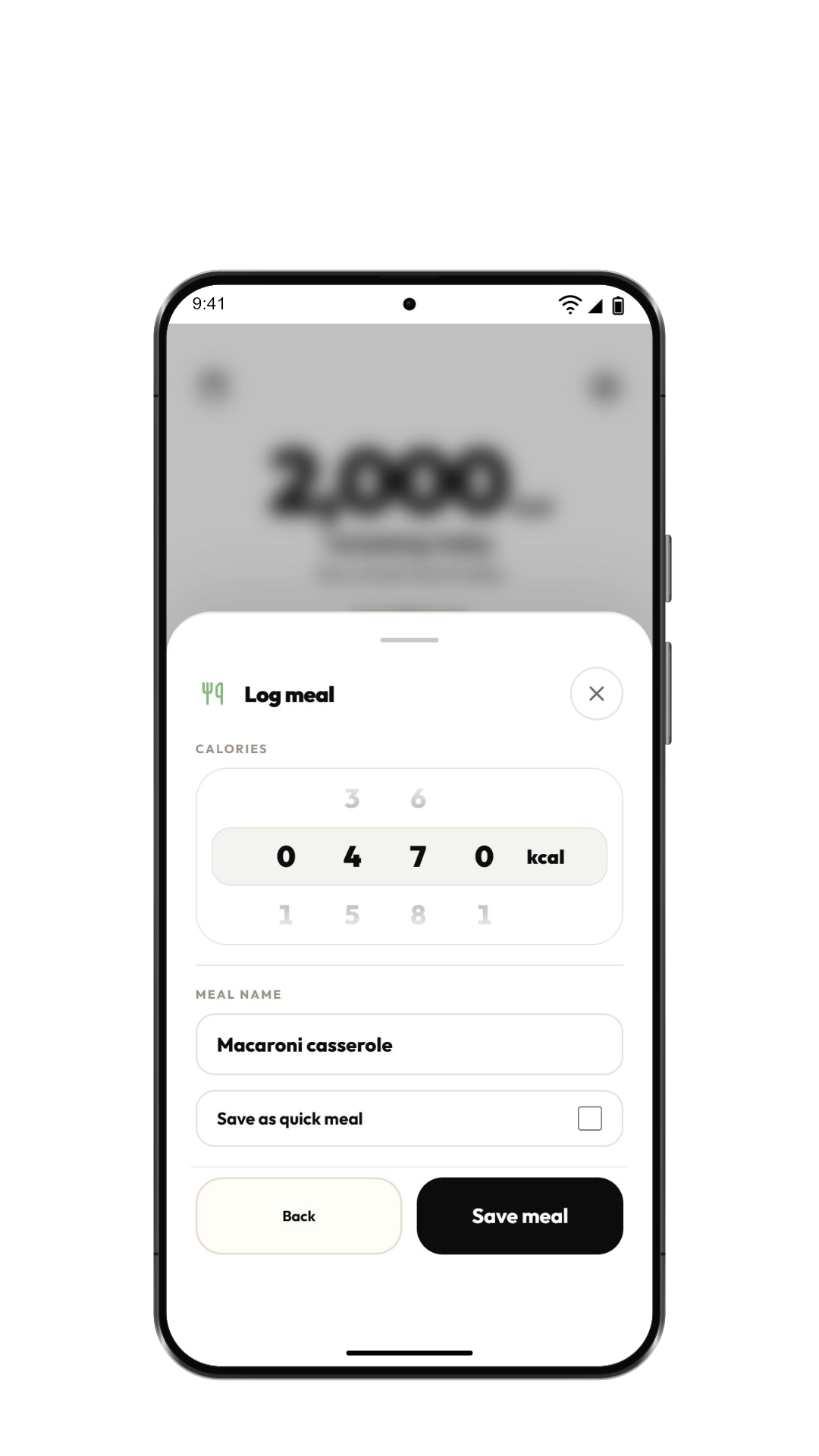
1. Log 470 calories
Open meal logging and choose the option for known calories. Enter 470 kcal, name the meal and save it. You can also add it as a quick selection.
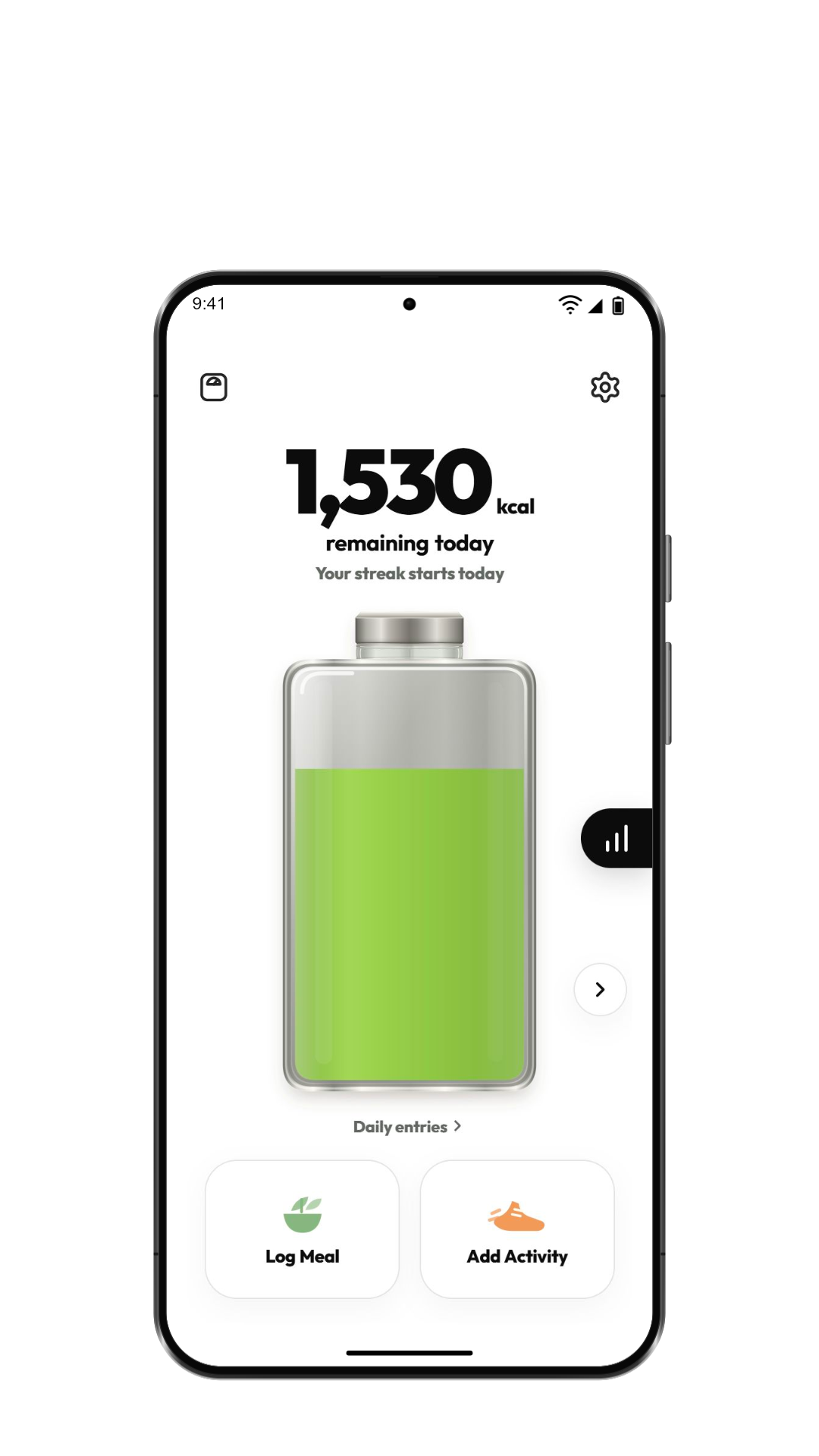
2. See what is left
The example day starts with 2,000 calories. After the casserole, 1,530 calories remain. The app subtracts the meal for you.
Edited example screens. 2,000 kcal is an example budget, not a personal calorie recommendation. Web calculator values do not transfer to the app automatically.
For iPhone and Android. Manual logging is free, with no account needed.
Prefer an estimate from a photo or text?
Calotank Pro can estimate meal calories. Review the estimate before saving. This is a paid feature.
See how calories from a photo works →Make calorie tracking fit your day
Your daily balance at a glance
Your calorie budget shows how much is left. Manual meal logging and budget tracking are free.
Include your activity
You can enter the calories for an activity. Logged activity adds calories to your daily budget.
Flex gives you flexibility
Flex is a calorie bank: calories saved from your budget build up as flexibility and cover small overages on other days. Savings can also pay for a Joker day — a break from logging.
How many calories do I need per day?
A meal’s energy content and your daily energy needs are different things. The daily calorie calculator estimates maintenance calories and lets you explore a weight-loss goal.
Open the daily calorie calculator →Calorie counting questions
Should I weigh pasta raw or cooked?
Match the nutrition entry to what you weigh. Dry pasta nutrition values apply to dry pasta weight. For cooked pasta weight, use a cooked pasta entry. Cooking changes weight through water, so the same gram weights are not directly comparable. Check whether the label describes the product as sold or prepared. [2]
Can I count calories without a scale?
Use the weight of a whole package, a serving stated on the label, or known piece and volume measures. Half a 200 g pot is about 100 g. A plateful varies considerably in size and remains an estimate. A scale helps you measure the quantity more precisely.
How do I include oils, sauces and drinks?
Include the cooking fat, sauces, spreads and drinks you consume. If the recipe total already includes them, do not count them again. Use millilitres for drinks when the label gives energy per 100 ml.
How do I estimate a restaurant meal?
Use the restaurant’s own portion information when available. Otherwise, look up a similar dish and estimate the portion and sides. Oil, sauce and portion size are not always clear from appearance. Photo calorie estimates may also need correction.
Are calories and kilocalories the same?
In everyday food language, “calorie” usually means a kilocalorie, or kcal. On this page, 160 calories means 160 kcal. The kJ value on a label is a different energy unit; do not enter it in the kcal field.
How accurate is the calculation?
The calculation uses the numbers you enter. Food labels and Fineli composition values are averages, and estimating portions can add uncertainty. Calories alone do not describe a food’s nutritional quality.
Sources and worked examples
The guide uses the Finnish Food Authority’s nutrition labelling guidance and THL’s Fineli database guidance. The yoghurt and casserole are worked examples created for this guide. Always check your own product’s values.
Calotank · Updated